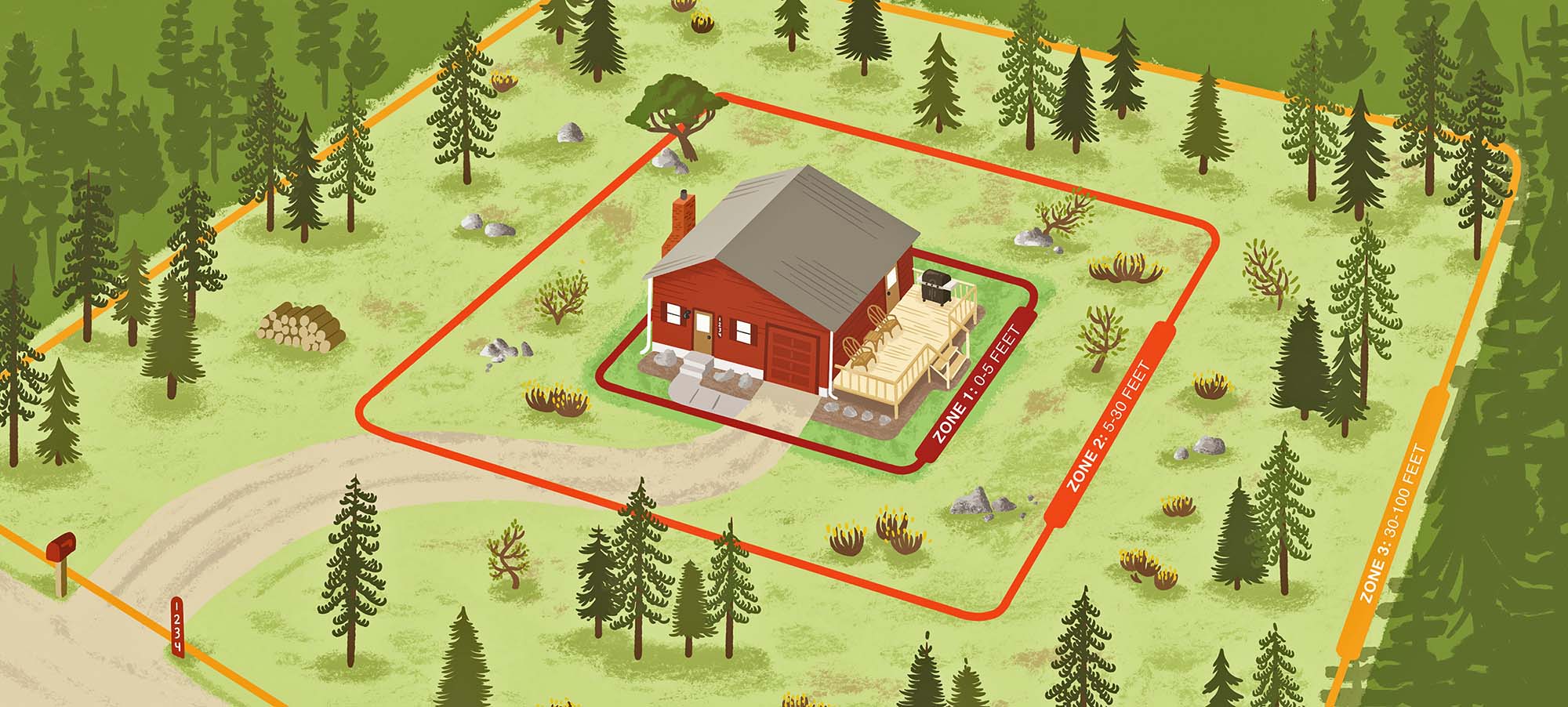
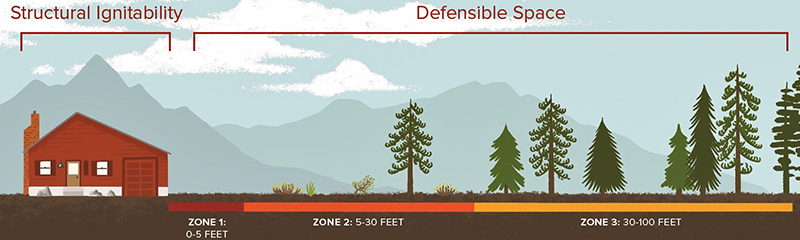
Defensible space refers to the modified area surrounding a residence or any other building, aimed at minimizing the risks associated with wildfires. Within this designated area, both natural and manmade fuel sources are managed, cleared, or diminished to impede the rapid spread of fires.The establishment of defensible space diminishes the probability of a structure catching fire through direct contact with flames or the heat radiated by the fire. It also assists in minimizing the generation of embers and decreases the likelihood of a building fire extending to nearby residences or surrounding vegetation.
The capacity of a home to withstand a wildfire is primarily influenced by two key factors: the inflammability of the structure itself and the effectiveness of the adjacent defensible space. When considered in conjunction, these factors form a crucial concept known as the home ignition zone (HIZ), which encompasses both the building itself and the immediate surrounding area.
Zone 1 refers to the immediate vicinity surrounding a home or any other structure. This zone extends up to 0-5 feet from the building and necessitates the utmost attention in order to minimize potential hazards. The primary objective in Zone 1 is to prevent direct contact between flames and the structure itself.
Actions to Consider:
Zone 2, located 5-30 feet away from your home, is specifically designated to minimize the fuel available to an approaching fire.
Actions to Consider:
Note: The horizontal spacing recommendations provided are minimums. It may be advisable to increase the spacing, especially on slopes, to further reduce the potential for fire behavior. Consult a forestry, fire, or natural resource professional for guidance on spacing recommendations for slopes.
The goal of this zone is to implement measures that prevent fires from spreading vertically and to promote forest health. A healthy forest consists of trees of various ages, sizes, and species, with sufficient space for growth. If the distance of 100 feet to the boundary of Zone 3 extends beyond your property, it is recommended to collaborate with adjacent property owners to establish a suitable defensible space. In cases where your house is situated on steep slopes or features specific topographic conditions, this zone may need to be expanded.
Actions to Consider:

The wildland-urban interface (WUI) refers to the overlap of human development with natural terrain and flammable vegetation, making uncontrolled wildland fires especially dangerous in these areas. Over the past few decades, there has been a significant increase in population within the interface. In Colorado, wildfires play a vital role in maintaining and restoring the health of our ecosystems. Forested lands, which have historically experienced regular fires necessary for their well-being, are now being developed with homes, businesses, and subdivisions. To safeguard human lives and properties, firefighters have put tremendous effort into suppressing and controlling fires. Unfortunately, this has had adverse consequences on the proper functioning of ecosystems.
The distance between the outermost branches of trees, measured from one tree to the nearest branch on the adjacent tree.
Duff refers to the layer of decomposing organic matter, such as leaves, twigs, and dead vegetation, that accumulates on the forest floor.
Branches, bushes, small trees and other natural debris.
Smaller trees and brush that provide vertical continuity, which allows a fire to burn from the ground level up into the branches and crowns of larger trees.
Trees uprooted or broken by wind.
An area in which fuel density is reduced to help improve fire control opportunities.
Community Wildfire Protection Plans are authorized and defined in Title I of the Healthy Forests Restoration Act (HFRA) passed by Congress on November 21, 2003, and signed into law by President Bush on December 3, 2003.
Learn about CWPP components, mitigation income tax subtraction, and Colorado’s specific CWPPs:
The Colorado Forest Atlas is a web portal providing a suite of interactive mapping applications about Colorado’s forests.
These applications provide Colorado with the best available information about forest conditions and Colorado State Forest Service activities, including the wildfire risk viewer, forest action plan, and wildfire risk reduction planner.
Six counties of the San Luis Valley collaborated with Headwaters Economics and the Community Planning Assistance for Wildfire program to develop an interactive website with maps of wildfire risk, housing trends, and watershed importance.
Wildfire mitigation refers to the proactive measures taken to reduce the risk and impact of wildfires on communities and ecosystems. It involves implementing various strategies and practices to minimize the potential spread, intensity, and damage caused by wildfires. The primary goals of wildfire mitigation are:
Protecting Human Lives and Property: One of the most critical aspects of wildfire mitigation is safeguarding human lives and homes. By implementing mitigation measures such as creating defensible space around structures, improving emergency preparedness, and enhancing firefighting capabilities, the risk to communities can be reduced, and the potential for casualties and property loss can be minimized.
Preserving Natural Resources: Wildfires can have devastating ecological consequences, including the destruction of forests, wildlife habitats, and vegetation. Mitigation efforts aim to minimize the impact on natural resources by reducing the severity and size of wildfires. This helps preserve biodiversity, maintain ecosystem functionality, and support long-term ecological health.
Safeguarding Water Supplies: Wildfires can have detrimental effects on water quality and supply. Intense wildfires can lead to increased erosion, sedimentation in water bodies, and damage to watersheds. By mitigating the risk of wildfires, communities can protect their water resources and ensure a sustainable water supply.
Reducing Air Pollution and Health Risks: Wildfires emit vast amounts of smoke, pollutants, and fine particulate matter into the air, which can pose significant health risks, especially for vulnerable populations. Mitigation efforts, such as fuel reduction projects, prescribed burns, and early detection systems, can help reduce the frequency and intensity of wildfires, thereby minimizing air pollution and associated health hazards.
Economic Considerations: Wildfires have substantial economic costs, including the expenses related to firefighting operations, property damage, post-fire recovery, and the loss of tourism and other industries. By investing in wildfire mitigation, communities can potentially reduce these economic burdens and promote long-term resilience.
Permaculture is a holistic approach to sustainable design and agriculture that seeks to create harmonious and self-sustaining systems modeled after natural ecosystems. Coined by Bill Mollison and David Holmgren in the 1970s, the term “permaculture” combines “permanent” and “agriculture” (or “culture”) to represent its core principles of long-term sustainability and ecological harmony.
Permaculture encompasses a broad range of practices and disciplines, including organic farming, agroforestry, ecological design, regenerative agriculture, and community development. It aims to create productive and resilient systems that mimic the patterns and relationships found in nature. By observing and understanding the principles of ecosystems, permaculture aims to design human systems that are both efficient and ecologically sound.
Key principles of permaculture:
Permaculture can be applied to various scales, from small-scale urban gardens to large agricultural systems. It seeks to integrate different elements such as plants, animals, water, buildings, and people in a way that fosters a sustainable and regenerative relationship between humans and the environment.
Overall, permaculture provides a framework for designing and implementing systems that promote ecological sustainability, social well-being, and resilience in the face of environmental challenges.
The objective of fire mitigation is not to engage in extensive tree removal, but rather to collaborate with the natural beauty of the property, resulting in a forest that is both visually appealing and healthier once the work is finished.
Our fire mitigation projects involve the use of selective thinning techniques. Initially, our focus is on identifying and removing dead, diseased, downed, and dying trees. Only after that do we proceed to selectively remove healthier trees to ensure appropriate spacing between tree crowns.
Fire mitigation not only reduces the risk of wildfires but also fosters a healthier forest that is more resilient against potential diseases. The most intensive thinning occurs within a distance of 0-30′ from structures, followed by a tiered approach from 30-100′ and beyond.